AI is making consequential decisions at scale. The question is whether the humans nominally in charge are actually in charge.
AuraSpark™ Technologies builds the governance and constraint architecture that makes human oversight real—not symbolic. Our systems are designed from first principles for environments where decisions must be traceable, explainable, and defensible.
High-level overview only. Detailed, enabling technical disclosures are provided under a mutual NDA.
The governance gap
As AI systems proliferate into high-stakes domains—clinical decisions, autonomous operations, financial oversight, critical infrastructure—the humans nominally responsible increasingly occupy positions of symbolic rather than genuine control. They approve outputs they cannot fully audit, evaluate against alternatives, or reliably override when judgment calls for it.
AuraSpark's architecture closes that gap. We build constraint enforcement and oversight infrastructure designed to give the person in charge the tools to understand, evaluate, and override AI decisions—with an evidence trail intended to support regulatory scrutiny.
The problems we solve
Nominal oversight without genuine control
When AI handles consequential decisions, human reviewers need architecture—not just authority—to exercise real oversight.
Black-box decisions that can’t be defended
Regulators, operators, and courts need traceable reasoning. We build systems that produce defensible decision trails as a first-class output.
Unpredictable behavior in edge cases
Real-world autonomy needs constraint enforcement, safety guardrails, and structured fallbacks—not just strong lab performance.
Focused initial deployments
DoD AI governance
The U.S. Department of Defense is deploying AI-enabled autonomous systems faster than governance architecture can keep pace. AuraSpark’s AURA (Autonomous Unified Reliability Architecture) portfolio provides the constraint enforcement and genuine human oversight infrastructure that makes AI-assisted decisions in defense contexts auditable, overridable, and accountable.
- Provider-independent hierarchical constraint enforcement (PIHCE / AURA-032)
- Fleet continual learning with adaptive validation (FCL-AVal) for autonomous platforms
- Weapon system oversight with immutable audit trails and genuine human authority
- I/ITSEC 2026 — abstract under review
- AFWERX 26.1 SBIR — submission in progress
Rugged adaptive drone
A patent-pending multirotor airframe engineered for demanding real-world operations—with redundant systems, fail-operational autonomy, and the ability to adapt its behavior on the fly when sensors degrade, conditions shift, or components fail. Built for environments where reliability is non-negotiable.
- Redundant sensing and fault-tolerant flight control for continued operation under degradation
- PHM-aware autonomy: real-time health monitoring drives adaptive mission replanning
- Detect-and-avoid and dynamic re-tasking when vehicle health or conditions change
- Audit-ready evidence stack for defensible BVLOS operations and FAA Part 108 readiness
A platform architecture, not a single product
The same governance and constraint enforcement architecture that powers the AURA portfolio extends across more than 80 identified solution applications—spanning defense, healthcare, legal, finance, transportation, cybersecurity, energy, and autonomous systems. The breadth of the catalog reflects the depth of the underlying architecture, not a scattered product roadmap.
How AuraSpark works
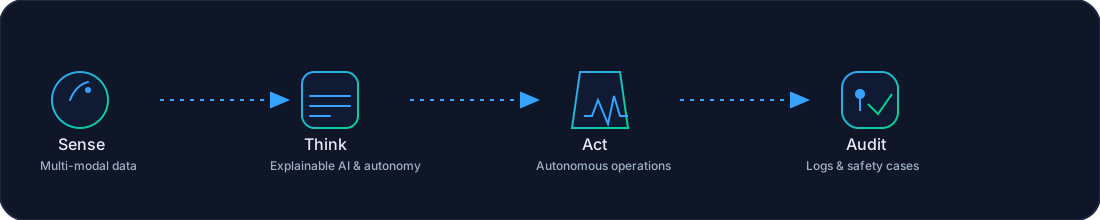
Sense
Multi-modal sensing and telemetry to capture operational evidence in real time.
Think
Explainable models and decision logic designed for scrutiny—not mystery.
Act
Workflow-integrated actions with constraint enforcement and human oversight.
Audit
Structured decision trails and logs to support validation, governance, and post-incident review.
Why AuraSpark
Patent-backed architecture
35+ pending USPTO applications spanning AI governance, constraint enforcement, and autonomous systems architectures across defense, clinical, and enterprise applications.
Audit-first by design
Evidence trails are a core deliverable—enabling trust, regulatory compliance, and continuous improvement in the field.
Systems engineering depth
Founded by an ESEP-certified systems engineer with 30+ years in safety-critical, complex systems. Governance requirements are specified before architecture—not retrofitted after.
FAA Part 108 readiness
Safety case, CONOPS, and operational artifacts aligned to the emerging BVLOS regulatory framework. Full readiness materials at aurasparkdrone.com.
Recent milestones
arXiv submission — under review
Beyond Symbolic Control: submitted to arXiv cs.CY, currently under review. Formalizes the nominal vs. genuine human oversight distinction as a systems engineering design requirement with five derived architectural requirements.
I/ITSEC 2026 — 3 abstracts accepted
Three papers accepted on AI governance architecture for autonomous systems in simulation and defense training environments—the world’s largest modeling, simulation, and training conference.
NeurIPS 2026 — workshop submission
Abstract submitted to the NeurIPS 2026 workshop track. Extends the genuine vs. nominal oversight framework into agentic AI containment contexts (AURA FARADAY).
MODSIM World 2026 — abstract under review
Abstract submitted on AI governance for autonomous systems in modeling, simulation, and training environments. 35+ active USPTO patent applications span defense, clinical, and enterprise governance architectures.
Talk to us
Investors
We support investor diligence under NDA, including architecture summaries, IP strategy, and milestone-based execution plans.
Pilot partners
If you’re exploring an early pilot or design partnership in autonomous systems or DoD governance (e.g., SCARS/AEGIS), we’d like to talk.
Co-founders
We’re forming a small founding team for autonomy, AI governance, and regulated deployments.